 62d8d6aaab
* fix typo in roadmap.md, add new diagram, refine README

* fix typo

Signed-off-by: 周鹏飞@yunify <pengfeizhou@yunify.com>
190 lines
10 KiB
Markdown
190 lines
10 KiB
Markdown
# KubeSphere
|
||
[](https://github.com/KubeSphere/KubeSphere/blob/master/LICENSE)
|
||
[](https://travis-ci.org/kubesphere/kubesphere)
|
||
[](https://goreportcard.com/report/github.com/kubesphere/kubesphere)
|
||
[](https://github.com/kubesphere/kubesphere/releases/tag/v2.1.0)
|
||
|
||

|
||
|
||
----
|
||
|
||
## What is KubeSphere
|
||
|
||
> English | [中文](README_zh.md)
|
||
|
||
[KubeSphere](https://kubesphere.io/) is a multi-tenant enterprise-grade container platform built on [Kubernetes](http://kubernetes.io), with full-stack automated IT operation and streamlined DevOps workflows. KubeSphere provides developer-friendly wizard web UI, helps enterprises to build out a more robust and feature-rich platform, includes most common functionalities needed for enterprise Kubernetes strategy, such as the **Kubernetes resource management, DevOps (CI/CD), application lifecycle management, monitoring, logging, Service Mesh (Istio-based), multi-tenancy, alerting and notification, storage and networking, autoscaling, access control, GPU support, etc.**, as well as **multi-cluster management, Network Policy, registry management, security** in upcoming releases. KubeSphere is going to be a **distributed operating system with cloud native stack** based on Kubernetes, will be very well architected for **plug-and-play integration with its ecosystem** as well.
|
||
|
||
KubeSphere provides a complete user experience around Kubernetes that incorporates a rich set of cloud native ecosystem tools, allows developers and DevOps teams use their favorite tools in a single front-end interface. KubeSphere delivers **consolidated views while integrating a wide breadth of ecosystem tools** upon Kubernetes and offer **consistent user experience** to reduce complexity. Most importantly, these functionalities are loosely coupled with the platform since they are pluggable and optional based on your demands, will not impact the flexibilty of Kubernetes.
|
||
|
||

|
||
|
||
|
||
> Note: The [Screenshots](docs/en/guides/screenshots.md) give a close insight into KubeSphere, see [What is KubeSphere](https://kubesphere.io/docs/v2.1/en/introduction/what-is-kubesphere) for details.
|
||
|
||
|
||
<table>
|
||
<tr>
|
||
<td width="50%" align="center"><b>KubeSphere Dashboard</b></td>
|
||
<td width="50%" align="center"><b>Project Resources</b></td>
|
||
</tr>
|
||
<tr>
|
||
<td><img src="https://pek3b.qingstor.com/kubesphere-docs/png/20191112094014.png"/></td>
|
||
<td><img src="https://pek3b.qingstor.com/kubesphere-docs/png/20191112094426.png"/></td>
|
||
</tr>
|
||
<tr>
|
||
<td width="50%" align="center"><b>CI/CD Pipeline</b></td>
|
||
<td width="50%" align="center"><b>Application Store</b></td>
|
||
</tr>
|
||
<tr>
|
||
<td><img src="https://pek3b.qingstor.com/kubesphere-docs/png/20190925000712.png"/></td>
|
||
<td><img src="https://pek3b.qingstor.com/kubesphere-docs/png/20191112095006.png"/></td>
|
||
</tr>
|
||
</table>
|
||
|
||
## Video on Youtube
|
||
|
||
[](https://youtu.be/u5lQvhi_Xlc)
|
||
|
||
## Demo Environment
|
||
|
||
Using the account `demo1 / Demo123` to log in the [demo environment](https://demo.kubesphere.io/). Please note the account is granted viewer access.
|
||
|
||
## Features
|
||
|
||
KubeSphere provides an easy-to-use console with awesome user experience that allows you to quickly get started with a container management platform. KubeSphere provides and supports the following major features:
|
||
|
||
|
||
- Workload management
|
||
- Service mesh (Istio-based)
|
||
- DevOps (CI/CD Pipeline)
|
||
- Source to Image, Binary to Image
|
||
- Multi-tenant management
|
||
- Multi-dimensional and multi-tenant monitoring, logging, alerting, notification
|
||
- Service and network management
|
||
- Application store and application lifecycle management
|
||
- Node and storage class management, image registry management
|
||
- Integrated Harbor, GitLab, SonarQube
|
||
- LB controller for Kubernetes on bare metal ([Porter](https://github.com/kubesphere/porter)), [cloud LB plugin](https://github.com/yunify/qingcloud-cloud-controller-manager)
|
||
- Support GPU node, support [vGPU](https://github.com/virtaitech/orion)
|
||
|
||
|
||
It also supports a variety of open source storage solutions and cloud storage products as the persistent storage services, as well as supports multiple open source network plugins.
|
||
|
||
> Note: See this [document](https://kubesphere.io/docs/v2.1/en/introduction/features/) which elaborates on the KubeSphere features and services.
|
||
|
||
----
|
||
|
||
## Architecture
|
||
|
||
KubeSphere uses a loosely-coupled architecture that separates the [frontend](https://github.com/kubesphere/console) from the [backend](https://github.com/kubesphere/kubesphere), the back end can also be connected with external systems through the REST API, all components are designed as Docker containers. See [Architecture](https://kubesphere.io/docs/v2.1/en/introduction/architecture/) for details.
|
||
|
||
|
||
## Latest Release
|
||
|
||
KubeSphere 2.1.0 was released on **November 12nd, 2019**. Check the [Release Notes For 2.1.0](https://kubesphere.io/docs/v2.1/zh-CN/release/release-v210/) for the updates.
|
||
|
||
## Installation
|
||
|
||
KubeSphere can run anywhere from on-premise datacenter to any cloud to edge. In addition, it can be deployed on any Kubernetes distribution.
|
||
|
||
> Attention: The following section is only used for minimal installation by default, see [Complete Installation Guide](https://kubesphere.io/docs/v2.1/en/installation/intro/) for details.
|
||
|
||
### Deploy on Existing Kubernetes
|
||
|
||
**Prerequisites**
|
||
|
||
> - `Kubernetes version`: `1.13.0 ≤ K8s version < 1.16`;
|
||
> - `Helm version`: `2.10.0 ≤ Helm < 3.0.0`,(will support Helm v3 in KubeSphere v3.0) see [Install and Configure Helm in Kubernetes](https://devopscube.com/install-configure-helm-kubernetes/);
|
||
> - CPU > 1 Core,Memory > 2 G;
|
||
> - An existing Storage Class in your Kubernetes clusters, use `kubectl get sc` to verify it.
|
||
|
||
Run the following command. When all Pods of KubeSphere are running, it means the installation is successsful. Then you can use `http://<IP>:30880` to access the dashboard with default account `admin/P@88w0rd`.
|
||
|
||
```yaml
|
||
$ kubectl apply -f https://raw.githubusercontent.com/kubesphere/ks-installer/master/kubesphere-minimal.yaml
|
||
```
|
||
|
||
|
||
### Deploy on Linux
|
||
|
||
KubeSphere Installer can help you to install KubeSphere and Kubernetes on your linux machines. It provides [All-in-One](https://kubesphere.com.cn/docs/v2.1/en/installation/all-in-one/) and [Multi-Node](https://kubesphere.com.cn/docs/v2.1/en/installation/multi-node/) installation options.
|
||
|
||
**Prerequisites**
|
||
|
||
- Operating Systems
|
||
- CentOS 7.5 (64 bit)
|
||
- Ubuntu 16.04/18.04 LTS (64 bit)
|
||
- Red Hat Enterprise Linux Server 7.4 (64 bit)
|
||
- Debian Stretch 9.5 (64 bit)
|
||
- Hardware
|
||
- CPU:2 Core, Memory:4 G, Disk Space:100 G
|
||
|
||
##### All-in-One
|
||
|
||
For those who are new to KubeSphere and looking for the easiest way to install and experience the dashboard. Execute the following commands to download and install KubeSphere in a single node.
|
||
|
||
```bash
|
||
$ curl -L https://kubesphere.io/download/stable/v2.1.0 > installer.tar.gz \
|
||
&& tar -zxf installer.tar.gz && cd kubesphere-all-v2.1.0/scripts
|
||
$ ./install.sh
|
||
```
|
||
|
||
Choose `"1) All-in-one"` to start the installation without changing any configuration.
|
||
|
||
> Note: In a development or production environment, it's highly recommended to install Multi-Node KubeSphere.
|
||
|
||
|
||
## To start using KubeSphere
|
||
|
||
### Quick Start
|
||
|
||
KubeSphere provides 12 quick-start tutorials to walk you through the platform.
|
||
|
||
- [Get Started - En](https://kubesphere.io/docs/v2.1/en/quick-start/admin-quick-start/)
|
||
- [Get Started - 中](https://kubesphere.io/docs/v2.1/zh-CN/quick-start/admin-quick-start/)
|
||
|
||
|
||
### Documentation
|
||
|
||
- KubeSphere Documentation ([En](https://kubesphere.io/docs/en/)/[中](https://kubesphere.io/docs/zh-CN/))
|
||
- [API Documentation](https://kubesphere.io/docs/v2.1/en/api-reference/api-docs/)
|
||
|
||
|
||
## To start developing KubeSphere
|
||
|
||
The [development guide](CONTRIBUTING.md) hosts all information about building KubeSphere from source, git workflow, how to contribute code and how to test.
|
||
|
||
## RoadMap
|
||
|
||
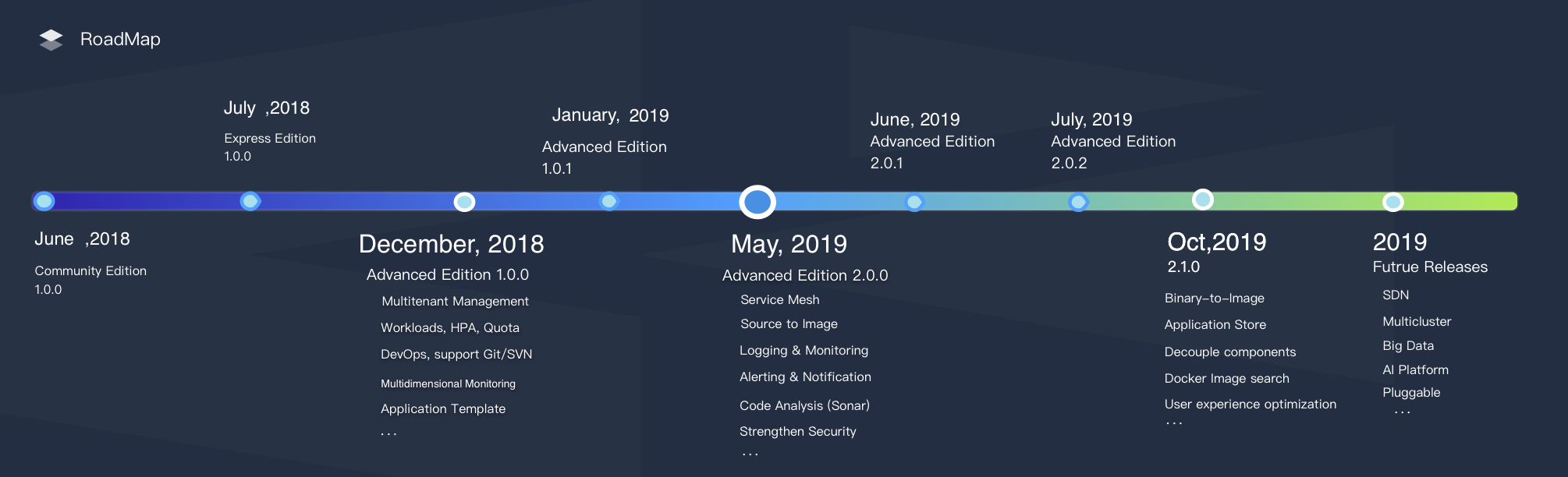
Currently, KubeSphere has released the following 4 major editions. The future releases will include Multicluster, Big data, AI, SDN, etc. See [Plans for 2.1.1 and 3.0.0](https://github.com/kubesphere/kubesphere/issues/1368) for more details.
|
||
|
||
**Express Edition** => **v1.0.x** => **v2.0.x** => **v2.1.0** => **v2.1.1** => **v3.0.0**
|
||
|
||
|
||
|
||
## Landscapes
|
||
|
||
<p align="center">
|
||
<br/><br/>
|
||
<img src="https://landscape.cncf.io/images/left-logo.svg" width="150"/> <img src="https://landscape.cncf.io/images/right-logo.svg" width="200"/> <img src="https://www.cncf.io/wp-content/uploads/2017/11/certified_kubernetes_color.png" height="40" width="30"/>
|
||
<br/><br/>
|
||
KubeSphere is a member of CNCF and a <a href="https://www.cncf.io/certification/software-conformance/#logos">Kubernetes Conformance Certified platform
|
||
</a>, which enriches the <a href="https://landscape.cncf.io/landscape=observability-and-analysis&license=apache-license-2-0">CNCF CLOUD NATIVE Landscape.
|
||
</a>
|
||
</p>
|
||
|
||
## Who Uses KubeSphere
|
||
|
||
The [Powered by KubeSphere](docs/powered-by-kubesphere.md) page includes users list of the project. You can submit your institution name and homepage if you are using KubeSphere.
|
||
|
||
|
||
## Support, Discussion, and Community
|
||
|
||
If you need any help with KubeSphere, please join us at [Slack Channel](https://join.slack.com/t/kubesphere/shared_invite/enQtNTE3MDIxNzUxNzQ0LTZkNTdkYWNiYTVkMTM5ZThhODY1MjAyZmVlYWEwZmQ3ODQ1NmM1MGVkNWEzZTRhNzk0MzM5MmY4NDc3ZWVhMjE).
|
||
|
||
Please submit any KubeSphere bugs, issues, and feature requests to [KubeSphere GitHub Issue](https://github.com/kubesphere/kubesphere/issues).
|
||
|
||
## Contributing to the project
|
||
|
||
This [document](docs/en/guides/README.md) walks you through how to get started contributing KubeSphere.
|