
191 lines
8.6 KiB
Markdown
191 lines
8.6 KiB
Markdown
# KubeSphere
|
||
[](https://github.com/KubeSphere/KubeSphere/blob/master/LICENSE)
|
||
[](https://travis-ci.org/kubesphere/kubesphere)
|
||
[](https://goreportcard.com/report/github.com/kubesphere/kubesphere)
|
||
[](https://github.com/kubesphere/kubesphere/releases/tag/advanced-2.0.2)
|
||
|
||

|
||
|
||
----
|
||
|
||
## What is KubeSphere
|
||
|
||
> English | [中文](README_zh.md)
|
||
|
||
[KubeSphere](https://kubesphere.io/) is an enterprise-grade multi-tenant container management platform built on [Kubernetes](https://kubernetes.io). It provides an easy-to-use UI for users to manage application workloads and computing resources with a few clicks, which greatly reduces the learning curve and the complexity of daily work such as development, testing, operation and maintenance. KubeSphere aims to alleviate the pain points of Kubernetes including storage, network, security and ease of use, etc.
|
||
|
||
|
||
## Screenshots
|
||
|
||
> Note: The [Screenshots](docs/en/guides/screenshots.md) give a close insight into KubeSphere.
|
||
|
||
|
||
<table>
|
||
<tr>
|
||
<td width="50%" align="center"><b>KubeSphere Dashboard</b></td>
|
||
<td width="50%" align="center"><b>Project Resources</b></td>
|
||
</tr>
|
||
<tr>
|
||
<td><img src="https://pek3b.qingstor.com/kubesphere-docs/png/20191112094014.png"/></td>
|
||
<td><img src="https://pek3b.qingstor.com/kubesphere-docs/png/20191112094426.png"/></td>
|
||
</tr>
|
||
<tr>
|
||
<td width="50%" align="center"><b>CI/CD Pipeline</b></td>
|
||
<td width="50%" align="center"><b>Application Store</b></td>
|
||
</tr>
|
||
<tr>
|
||
<td><img src="https://pek3b.qingstor.com/kubesphere-docs/png/20190925000712.png"/></td>
|
||
<td><img src="https://pek3b.qingstor.com/kubesphere-docs/png/20191112095006.png"/></td>
|
||
</tr>
|
||
</table>
|
||
|
||
## Video on Youtube
|
||
|
||
[](https://youtu.be/u5lQvhi_Xlc)
|
||
|
||
## Demo Environment
|
||
|
||
Using the account `demo1 / Demo123` to log in the [demo environment](https://demo.kubesphere.io/). Please note the account is granted viewer access.
|
||
|
||
## Features
|
||
|
||
KubeSphere provides an easy-to-use console with awesome user experience that allows you to quickly get started with a container management platform. KubeSphere provides and supports the following major features:
|
||
|
||
|
||
- Workload management
|
||
- Service mesh (Istio-based)
|
||
- DevOps (CI/CD Pipeline)
|
||
- Source to Image, Binary to Image
|
||
- Multi-tenant management
|
||
- Multi-dimensional and multi-tenant monitoring, logging, alerting, notification
|
||
- Service and network management
|
||
- Application store and application lifecycle management
|
||
- Node and storage class management, image registry management
|
||
- Integrated Harbor, GitLab, SonarQube
|
||
- LB controller for Kubernetes on bare metal ([Porter](https://github.com/kubesphere/porter)), [cloud LB plugin](https://github.com/yunify/qingcloud-cloud-controller-manager)
|
||
- Support GPU node
|
||
|
||
|
||
It also supports a variety of open source storage solutions and cloud storage products as the persistent storage services, as well as supports multiple open source network plugins.
|
||
|
||
> Note: See this [document](https://docs.kubesphere.io/advanced-v2.0/zh-CN/introduction/features/) which elaborates on the KubeSphere features and services.
|
||
|
||
----
|
||
|
||
## Architecture
|
||
|
||
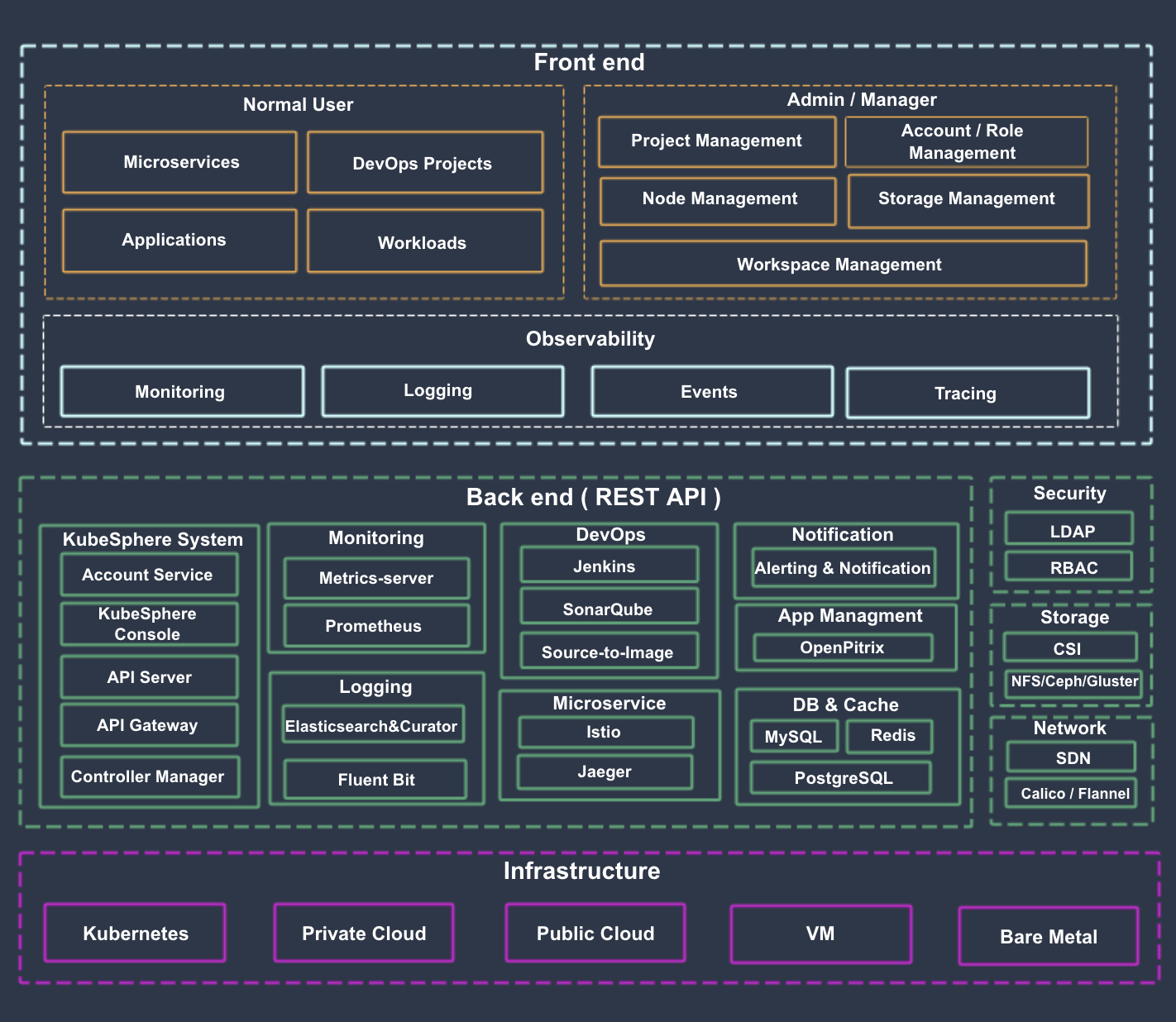
KubeSphere separates [frontend](https://github.com/kubesphere/console) and [backend](https://github.com/kubesphere/kubesphere) as shows below. KubeSphere can run anywhere from on-premise datacenter to any cloud to edge. In addition, it can be deployed on any Kubernetes distribution. Please check the [installation guide](https://github.com/kubesphere/ks-installer).
|
||
|
||
|
||
|
||
## Latest Release
|
||
|
||
KubeSphere 2.1.0 was released on **November 12nd, 2019**. Check the [Release Notes For 2.1.0](https://kubesphere.io/docs/v2.1/zh-CN/release/release-v210/) for the updates.
|
||
|
||
## Installation
|
||
|
||
> Attention: The following section is only used for minimal installation by default, KubeSphere has decoupled some core components in v2.1.0. For pluggable components installation, see `Enable Pluggable Components` below.
|
||
|
||
### Deploy on Existing Kubernetes
|
||
|
||
**Prerequisites**
|
||
|
||
> - `Kubernetes version`: `1.13.0 ≤ K8s version < 1.16`;
|
||
> - `Helm version` >= `2.10.0`,see [Install and Configure Helm in Kubernetes](https://devopscube.com/install-configure-helm-kubernetes/);
|
||
> - CPU > 1 Core,Memory > 2 G;
|
||
> - An existing Storage Class in your Kubernetes clusters, use `kubectl get sc` to verify it.
|
||
|
||
Run the following command. When all Pods of KubeSphere are running, it means the installation is successsful. Then you can use `http://<IP>:30880` to access the dashboard with default account `admin/P@88w0rd`.
|
||
|
||
```yaml
|
||
$ kubectl apply -f https://raw.githubusercontent.com/kubesphere/ks-installer/master/kubesphere-minimal.yaml
|
||
```
|
||
|
||
|
||
### Deploy on Linux
|
||
|
||
The installation is going to install KubeSphere and Kubernetes on your linux machines. It provides All-in-One and Multi-Node installation options.
|
||
|
||
- Operating Systems
|
||
- CentOS 7.5 (64 bit)
|
||
- Ubuntu 16.04/18.04 LTS (64 bit)
|
||
- Red Hat Enterprise Linux Server 7.4 (64 bit)
|
||
- Debian Stretch 9.5 (64 bit)
|
||
- Hardware
|
||
- CPU:2 Core, Memory:4 G, Disk Space:100 G
|
||
|
||
##### All-in-One
|
||
|
||
For those who are new to KubeSphere and looking for the easiest way to install and experience the dashboard. Execute the following commands to download and install KubeSphere in a single node.
|
||
|
||
```bash
|
||
$ curl -L https://kubesphere.io/download/stable/v2.1.0 > installer.tar.gz \
|
||
&& tar -zxf installer.tar.gz && cd kubesphere-all-v2.1.0/scripts
|
||
$ ./install.sh
|
||
```
|
||
|
||
Choose `"1) All-in-one"` to start the installation without changing any configuration.
|
||
|
||
> Note: In a development or production environment, it's highly recommended to install Multi-Node KubeSphere.
|
||
|
||
### Enable Pluggable Components
|
||
|
||
If you want to use optional components after the minimal installation as shown above, please execute following command to enable the pluggable components you prefer to start the installation. Make sure your cluster has enough CPU and memory in advance.
|
||
|
||
```
|
||
$ kubectl edit cm -n kubesphere-system ks-installer
|
||
```
|
||
|
||
## To start using KubeSphere
|
||
|
||
### Quick Start
|
||
|
||
KubeSphere provides 12 quick-start tutorials to walk you through the platform.
|
||
|
||
- [Get Started - En](https://github.com/kubesphere/kubesphere.github.io/tree/master/blog/advanced-2.0/en)
|
||
- [Get Started - 中](https://kubesphere.io/docs/v2.1/zh-CN/quick-start/admin-quick-start/)
|
||
|
||
|
||
### Documentation
|
||
|
||
- KubeSphere Documentation ([En](https://kubesphere.io/docs/en/)/[中](https://kubesphere.com.cn/docs/zh-CN/))
|
||
- [API Documentation](https://kubesphere.io/docs/v2.1/api/kubesphere)
|
||
|
||
|
||
## To start developing KubeSphere
|
||
|
||
The [development guide](CONTRIBUTING.md) hosts all information about building KubeSphere from source, git workflow, how to contribute code and how to test.
|
||
|
||
## RoadMap
|
||
|
||
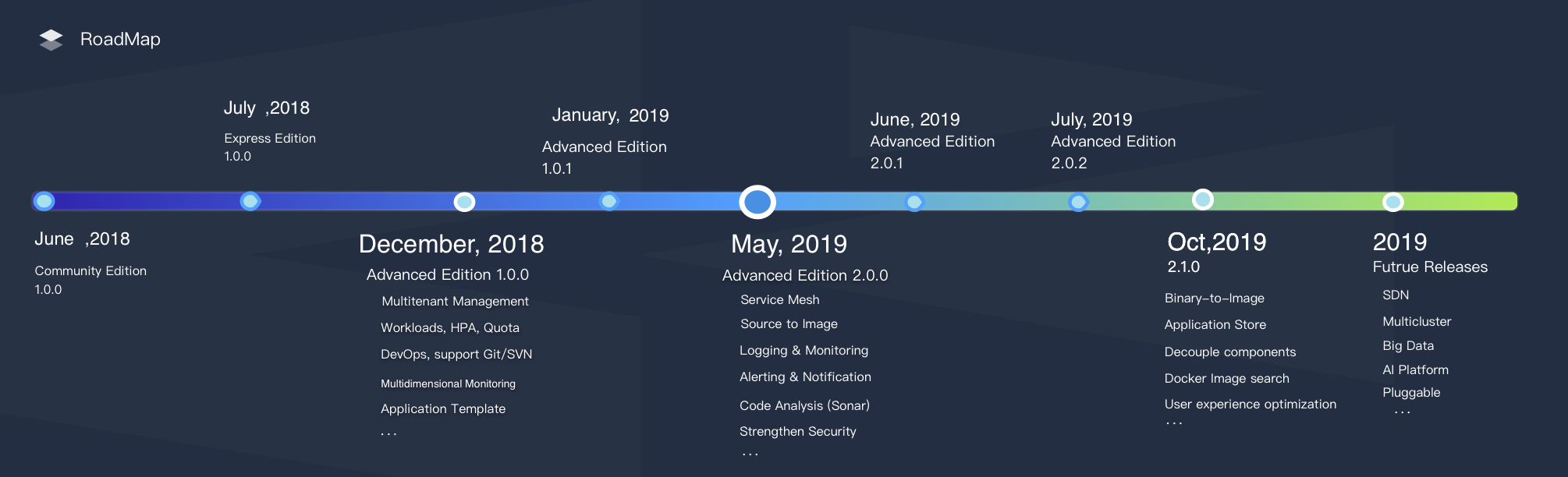
Currently, KubeSphere has released the following 4 major editions. The future releases will include Multicluster, Big data, AI, SDN, etc. See [Plans for 2.1.1 and 3.0.0](https://github.com/kubesphere/kubesphere/issues/1368) for more details.
|
||
|
||
**Express Edition** => **v1.0.x** => **v2.0.x** => **v2.1.0**
|
||
|
||
|
||
|
||
## Landscapes
|
||
|
||
<p align="center">
|
||
<br/><br/>
|
||
<img src="https://landscape.cncf.io/images/left-logo.svg" width="150"/> <img src="https://landscape.cncf.io/images/right-logo.svg" width="200"/> <img src="https://www.cncf.io/wp-content/uploads/2017/11/certified_kubernetes_color.png" height="40" width="30"/>
|
||
<br/><br/>
|
||
KubeSphere is a member of CNCF and a <a href="https://www.cncf.io/certification/software-conformance/#logos">Kubernetes Conformance Certified platform
|
||
</a>, which enriches the <a href="https://landscape.cncf.io/landscape=observability-and-analysis&license=apache-license-2-0">CNCF CLOUD NATIVE Landscape.
|
||
</a>
|
||
</p>
|
||
|
||
|
||
## Support, Discussion, and Community
|
||
|
||
If you need any help with KubeSphere, please join us at [Slack Channel](https://join.slack.com/t/kubesphere/shared_invite/enQtNTE3MDIxNzUxNzQ0LTZkNTdkYWNiYTVkMTM5ZThhODY1MjAyZmVlYWEwZmQ3ODQ1NmM1MGVkNWEzZTRhNzk0MzM5MmY4NDc3ZWVhMjE).
|
||
|
||
Please submit any KubeSphere bugs, issues, and feature requests to [KubeSphere GitHub Issue](https://github.com/kubesphere/kubesphere/issues).
|
||
|
||
## Contributing to the project
|
||
|
||
This [document](docs/en/guides/README.md) walks you through how to get started contributing KubeSphere.
|
||
|
||
|
||
|